

Non-Toxic Ball Pit Balls: What to Check and Safe Alternatives (UK 2026)
Quick answer: Non-toxic ball pit balls are made from PVC-free plastic (usually polyethylene) with no BPA or phthalates, and are sold with a UKCA or CE mark after testing to the EN 71 toy safety standard. Avoid balls that list no material, no seller address and no safety marking, or that still smell strongly of chemicals after a day of airing. For babies, use 7cm balls, which are too big to fit in a baby's mouth, and wash them regularly. If you'd rather skip plastic balls altogether, an empty foam pit, fabric balls or soft play blocks give the same kind of play.
Almost every pack of ball pit balls sold in the UK says "non-toxic" somewhere on it. The trouble is that "non-toxic" isn't a legal term, so on its own it tells you very little. What actually keeps your baby safe is the plastic the balls are made from, the testing behind them and how you look after them once they're in the pit.
At Soft Play Market we sell ball pit balls to families, nurseries and soft play centres across the UK, and the same questions come up again and again. This guide answers them: what to check on a listing, which plastics to avoid, what UK rules actually require, how to check a batch when it arrives, what's different for babies, and which alternatives work if you'd rather not use plastic balls.
Are ball pit balls toxic?
Ball pit balls sold legally in the UK shouldn't be. Toys here must meet the Toys (Safety) Regulations 2011, which set limits on harmful chemicals, and reputable balls are tested to EN 71 to show they do. The risk sits with balls that skip that process: unbranded listings shipped straight from overseas sellers, very old balls made from soft PVC, and second-hand balls of unknown origin.
So the useful question isn't "are ball pit balls toxic?" but "can this seller show me what these balls are made of and how they were tested?" If the answer is yes, you're in good shape. If the listing is silent, treat that as the warning sign.
What makes a ball pit ball non-toxic?
Three things, and you can check all of them before you buy.
- The plastic. Most good ball pit balls are made from polyethylene (PE), a soft, flexible plastic that stays squashy without added softening chemicals. Older and cheaper balls are sometimes made from PVC, which usually needs plasticisers to stay soft.
- What's left out. Look for "PVC-free", "BPA-free" and "phthalate-free" on the product page or pack. Phthalates are the plasticisers that toy rules restrict, and they're the main reason to avoid soft PVC toys for young children.
- Safety testing. Toys sold in Great Britain must carry a UKCA or CE mark. For balls, the standard to look for is EN 71, which covers physical safety, flammability and limits on certain chemical elements that could migrate from a toy.
If a listing doesn't say what the balls are made from or how they were tested, that matters much more than the price.
PE vs PVC ball pit balls: what's the difference?
| Polyethylene (PE) | PVC | |
|---|---|---|
| How it stays soft | Naturally flexible | Usually needs plasticisers |
| Phthalate risk | Very low | Higher, unless stated phthalate-free |
| Smell | Little or none | Can have a noticeable "plastic" smell |
| Feel | Light, springy, slightly waxy | Often heavier and stickier |
| Recycling code | 2 (HDPE) or 4 (LDPE) | 3 (PVC), rarely recycled |
| Typical use | Most modern ball pit balls | Older and very cheap balls |
If the product page doesn't name the plastic, ask the seller. A shop that knows its products will be able to tell you. For more on how balls are made and coloured, see our guide to what ball pit balls are made of.
What do UK rules say about chemicals in ball pit balls?
Ball pit balls are toys, so in Great Britain they fall under the Toys (Safety) Regulations 2011, with chemical limits also set by UK REACH. In practice, that means:
- A UKCA or CE mark on the product or packaging. Both marks are currently accepted in Great Britain.
- A named business responsible for the product, with an address on the pack or listing.
- Phthalate limits: DEHP, DBP, BBP and DIBP are limited to 0.1% by weight of the plastic in any toy or childcare article. DINP, DIDP and DNOP are limited to 0.1% in toys that children can put in their mouths, which in practice includes balls for babies.
- Element migration limits under EN 71-3, which caps how much of metals such as lead, cadmium and chromium can migrate out of a toy's material.
- Testing to harmonised standards such as EN 71, which is how most manufacturers show their toys meet the rules.
The weak spot is online marketplaces, where balls are often shipped directly from overseas sellers with no UK importer named. If you can't tell who's responsible for the product, nobody is checking it. Our ball pit safety standards guide covers the physical side too, including the extra standards that apply to commercial soft play.
How do you check a ball pit ball listing before you buy?
Run through this five-point checklist on any product page:
- Material named: polyethylene or PE, not just "plastic".
- Free-from claims: PVC-free, BPA-free and phthalate-free.
- Safety marking: UKCA or CE, ideally with EN 71 mentioned.
- Ball size: 7cm for babies and toddlers.
- Seller details: a real business name and address, plus a returns policy.
If you're buying for a nursery or play centre, or the listing leaves you unsure, ask the seller two questions: "Can you send the EN 71 test report or Declaration of Conformity for these balls?" and "Who is the responsible business in the UK or EU?" A legitimate seller can answer both. Vague replies are an answer in themselves.
Our own commercial-grade balls tick every box: made in the EU from flexible plastic with no PVC, BPA or phthalates, and tested to EN 71. For bigger pits they come in factory boxes of 750, and our 800-ball home bag is made from BPA-free, crush-resistant plastic.
 Ball Pit Balls - 7 CM - 750 PCS - Commercial Grade - Choose Your Colour - Non-PVC Plastic - Non-Toxic and BPA Free - Premium Quality
£142.50
View product
 800 PCS 7 CM Multi-Colour Ball Pit Balls - Durable & Non-Toxic
£178.80
View product
 Bearly Round Ball Pit with 200 Balls, 90x30cm, Creme
£173.95
View product
Are cheap ball pit balls toxic?
Not automatically. A low price usually means thinner plastic, so the balls dent, crack and need replacing sooner. That's a durability problem rather than a chemical one. The real risk comes from unbranded listings with no material, no seller address and no safety marking, because if those balls would fail a test, nobody is accountable.
A cheap pack that clearly lists PE, PVC-free and a CE or UKCA mark is a reasonable buy. An expensive pack that lists none of that isn't.
Are some ball colours safer than others?
No colour is safer by default. Ball pit balls get their colour from pigment mixed into the plastic before moulding, and the EN 71-3 migration limits apply to every colour in a batch, whether it's white, pastel, pearl or bright red. What matters is that the balls you're buying come from a tested batch, not which shade you pick. If a mixed pack includes one colour that smells noticeably different or feels sticky, set those balls aside and ask the seller about them.
What should you check when the balls arrive?
- Smell them. A faint new-plastic smell is normal. A strong chemical smell that's still there after a day of airing in a well-ventilated room is a reason to contact the seller.
- Squeeze a handful. Good balls dent under pressure and spring straight back. Balls that stay dented or crack are too thin.
- Check for seams and flashing. Run your hand over a few. There shouldn't be sharp ridges where the two halves were moulded.
- Look at the surface. It should feel smooth and dry. A greasy or tacky film on new balls is worth a question to the seller.
- Wash before first use. Even new balls have been handled in a factory and a warehouse. A quick wash (see below) is worth doing before your baby plays.
Which balls are safest for babies?
For babies, the safest choice is 7cm balls made from tested, PVC-free plastic, in a pit with soft walls and a padded base. Babies explore with their mouths, so three things matter more for them than for older children.
- Size. 7cm balls are too big to go into a baby's mouth, light enough for small hands to grab and throw, and they fill a pit evenly. Toy safety testing for under-3s treats any ball small enough to pass through a 44.5mm template as a choking hazard, so 7cm balls are well clear. Never mix smaller balls, marbles or loose toy parts into a baby's pit.
- Mouthing. Expect balls to be chewed. That's exactly why the phthalate limits for toys that go in the mouth matter, and why a ball with a crack or split edge should go straight in the bin.
- Cleanliness. Balls that have been mouthed need washing more often than balls in an older child's pit. Every two weeks at home is a sensible rhythm for a baby, and straight away after any illness.
Most babies are ready for a ball pit at around 6 months, once they can sit with support. Stay within arm's reach while they play, and keep the ball depth low at first so they can sit comfortably without sinking. Our guide to what age a ball pit is for goes through each stage in more detail.
Are there eco-friendly ball pit balls?
This is where honesty matters. Ball pit balls are plastic, and many "eco" claims are vague. What genuinely makes a difference:
- Buy balls that last. Thick-walled balls that don't crush stay in use for years. Replacing fewer balls is the biggest environmental win.
- Buy the right number once. Under-filling and then topping up means more packaging and more deliveries. Our ball pit size chart tells you how many you need.
- Buy in bulk. One large box uses far less packaging than lots of small bags. Our factory boxes of 750 balls are aimed at bigger pits, nurseries and soft play centres. They're made to order, so allow 3 to 4 weeks for delivery.
- Pass them on. PE is recyclable in principle, but most UK kerbside collections don't take toys. Good balls can go to a nursery, playgroup or another family instead of the bin.
Be wary of "biodegradable" ball pit balls with no certification or test standard named behind the claim. Our guide to how long ball pit balls last covers lifespan, care and second-hand balls.
What are the best alternatives to plastic ball pit balls?
If you'd rather avoid plastic balls, or want to start without them, there are good options. The right one depends mostly on your child's age.
| Alternative | Best for | Good points | Drawbacks |
|---|---|---|---|
| Empty foam ball pit with cushions | Babies learning to sit | Soft walls to lean on, no loose parts, add balls later | Less to grab and throw |
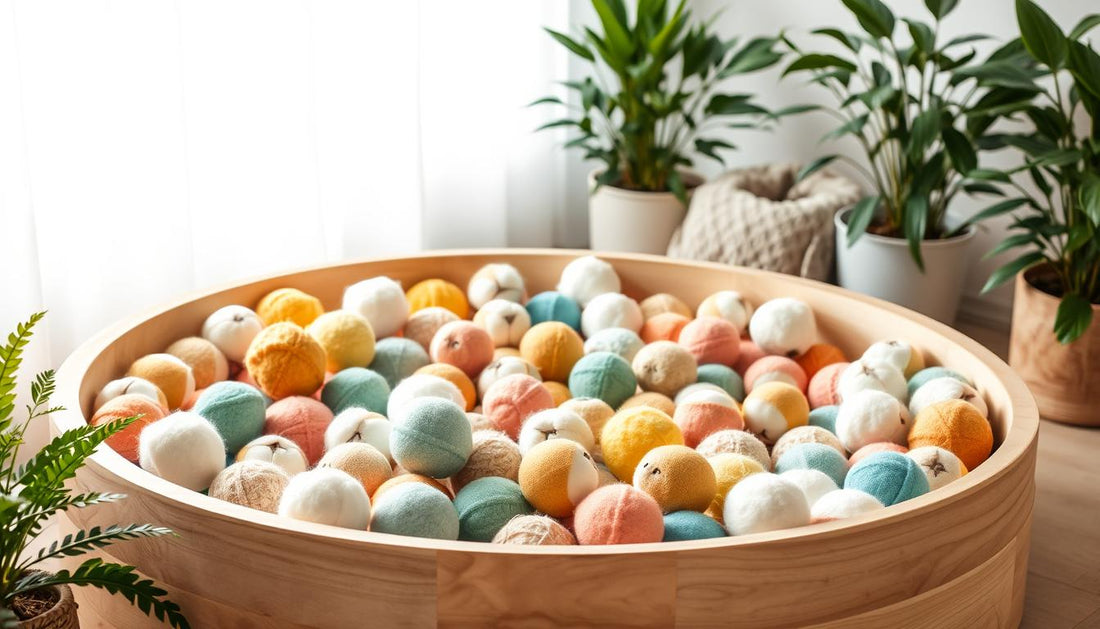
| Fabric or felt balls | Young babies | Soft, quiet, machine-washable covers on some | Heavy and slow to dry in bulk, so usually a few dozen, not a full pit |
| Foam play mat | Tummy time to crawling | Padded floor for rolling and reaching, folds away | No "sinking in" feel |
| Soft play blocks | Crawlers and toddlers | Climbing, stacking and building with no small parts | Takes floor space |
| Foam playset (slide, steps, pit) | Toddlers | Climbing and sliding with an optional pit | Bigger spend |
A few ideas you'll see online are best avoided for babies and toddlers: balloons (a well-known choking hazard when they burst), crumpled paper, which gets chewed into small pieces, and dried rice or pasta "sensory bins" for children who still mouth everything.
Many families start with an empty foam pit and a play mat for a young baby, then add 7cm balls once their child is sitting well. That way you get the play value early without buying anything you'll replace later.
 Bearly Foam 3 Elements Playset with Ball Pit 90x30cm Cream, without Balls
£320.95
View product
 Baby Cloud 160x160cm Foam Foldable Play Mat Certified, Velvet, Light Gray
 6-Piece Foam Building Blocks Set - Soft - Colorful - Kids Nursery Play Toy
£167.85
View product
You'll find more in our ball pits and soft play sets collections, and the full range of balls in balls for ball pits.
How do you keep ball pit balls clean and safe?
Clean balls matter as much as the plastic they're made from. At home, wash them every two to four weeks (every two for a baby who mouths them), or straight away after an illness. In a nursery or play centre, aim for weekly.
- Tip the balls into a bath or large tub, or put them in mesh laundry bags.
- Add warm water and a squeeze of mild washing-up liquid. Swish them around for a few minutes.
- Rinse in clean water.
- Spread them on towels to air dry completely before they go back in the pit, so damp balls don't sit together.
For smaller batches, a laundry net bag on a cool dishwasher cycle also works. Skip bleach and very hot water, which can make plastic brittle, and keep balls out of the washing machine, where the spin dents them. While you wash, throw away any ball that's cracked, split or won't spring back. Our full guide to cleaning a baby ball pit also covers the pit itself.
What can't a "non-toxic" label tell you?
Be realistic about what you can check. You can't test balls for phthalates or heavy metals at home, and a sniff test only catches the obvious problems. A clean smell doesn't prove a ball passed EN 71, and a slight smell doesn't prove it failed. That's why the seller's information (material, marking, test standard, named business) carries most of the weight. Buy from a seller who gives you all of it, and you've done what you reasonably can.
Frequently asked questions
Are ball pit balls safe for babies?
Yes, from around 6 months once your baby can sit with support, as long as the balls are 7cm, made from tested PVC-free plastic, and you stay close while they play.
Do ball pit balls contain BPA?
Good-quality ball pit balls don't. BPA is mostly found in hard, clear plastics rather than the soft polyethylene most balls are made from, but always look for "BPA-free" on the listing.
What does EN 71 mean on toys?
EN 71 is the European toy safety standard, also used in the UK. Its parts cover physical and mechanical safety (such as small parts and sharp edges), flammability and limits on chemical elements that could migrate from a toy.
Is a CE mark still valid in the UK?
Yes. Toys sold in Great Britain can carry either the UKCA or the CE mark.
Why do new ball pit balls smell?
A faint smell is normal for new plastic that has been sealed in a bag. Air the balls in a ventilated room for a day and wash them. If a strong chemical smell remains, contact the seller.
Can you put ball pit balls in the washing machine?
We don't recommend it, because the spin can dent them. A tub of warm soapy water is gentler and quicker for a full pit, and a net bag on a cool dishwasher cycle works for smaller batches.
How long do ball pit balls last?
Thick-walled balls in a home pit can last for years. Replace any ball that stays dented, cracks or develops a sharp edge, and expect thinner balls to need replacing sooner in busy nurseries and play centres.