

Ball Pit Buyer's Guide: How to Choose the Right Ball Pit for Your Child in 2026
Ball pit buyer's guide: how to choose the right ball pit for your child in 2026
At Soft Play Market, we help thousands of UK parents find the right soft play equipment for their children — and our ball pit buyer's guide UK is designed to cut through the noise so you can buy with confidence. Whether you need a compact pop-up pool for a six-month-old or a full foam play centre for an energetic four-year-old, choosing well means looking beyond colour and price to EN71 safety standards, foam density ratings, and whether the thing will actually fit in your living room.
Ball pits are among the most developmentally rewarding purchases you can make for children aged birth to six years. NHS developmental guidance confirms that sensory play stimulates cognitive growth, motor development, and social skills from the earliest months of life. The tactile experience of scooping, throwing, and sitting in a sea of balls builds hand-eye coordination, proprioceptive awareness, and imaginative play — all of which matter enormously in the first six years. The practical challenge is finding a pit that is genuinely safe, right-sized for a typical UK home, and built to last more than one season of enthusiastic use.
Every ball pit in our ball pits collection comes with free UK delivery on all orders, is CE certified and EN71 safety tested, and features wipe-clean covers for easy maintenance.
Types of ball pits available in the UK

Pop-up and foldable ball pools
Pop-up ball pools are the entry-level option and the most popular with parents who prioritise storage convenience. A lightweight frame — usually fibreglass or thin metal — with a fabric or mesh surround means the pool erects in minutes and folds flat when not in use. Typical dimensions run 90cm to 120cm in diameter and 25cm to 40cm deep, which fits comfortably in a corner of the average UK living room (around 4m × 5m) without eating the entire floor. Best suited to children aged 6 months to 3 years. Check that the frame stitching is reinforced at stress points and the zip entry opens smoothly but does not gape.
Foam-sided soft play ball pits
Foam-sided ball pits use panels of high-density foam — typically 25 to 40 kg/m³ — covered in wipe-clean PVC or Oxford fabric. The padded walls give children a safe surface to lean against, pull up on, and topple into without injury. Common footprints run from 100cm × 80cm up to 150cm × 120cm, with depths of 40cm to 60cm. Ideal for ages 1 to 5 years, these pits work well alongside wider play equipment. Our soft play sets include coordinated bundles with climbing elements and padded arches.
Modular foam playground systems
Modular systems treat the ball pit as one zone within a larger indoor play structure — climbing ramps, arched tunnels, foam slides, and interlocking blocks all feature alongside a dedicated ball area. Premium systems use CFC-free, OEKO-TEX certified foam at densities of 30 to 45 kg/m³. Designed for ages 1 to 6 years, these setups are well suited to households with children of different ages or families who want a single long-term investment rather than a sequence of smaller purchases. See the full range in our foam playgrounds collection.
Inflatable ball pits
Inflatables are the budget-friendly, cheerful option — PVC or nylon construction, inflated via electric pump, available in themed designs from jungle animals to space rockets. Typical size is around 100cm × 80cm with 30cm inflated sides. They pack away small and weigh almost nothing. The drawbacks are durability — PVC seams can split under heavy use — and hygiene, since textured inflatable surfaces trap dirt more readily than smooth PVC foam covers. Best for ages 6 months to 3 years under direct adult supervision.
What to look for when buying a ball pit

EN71 and CE certification
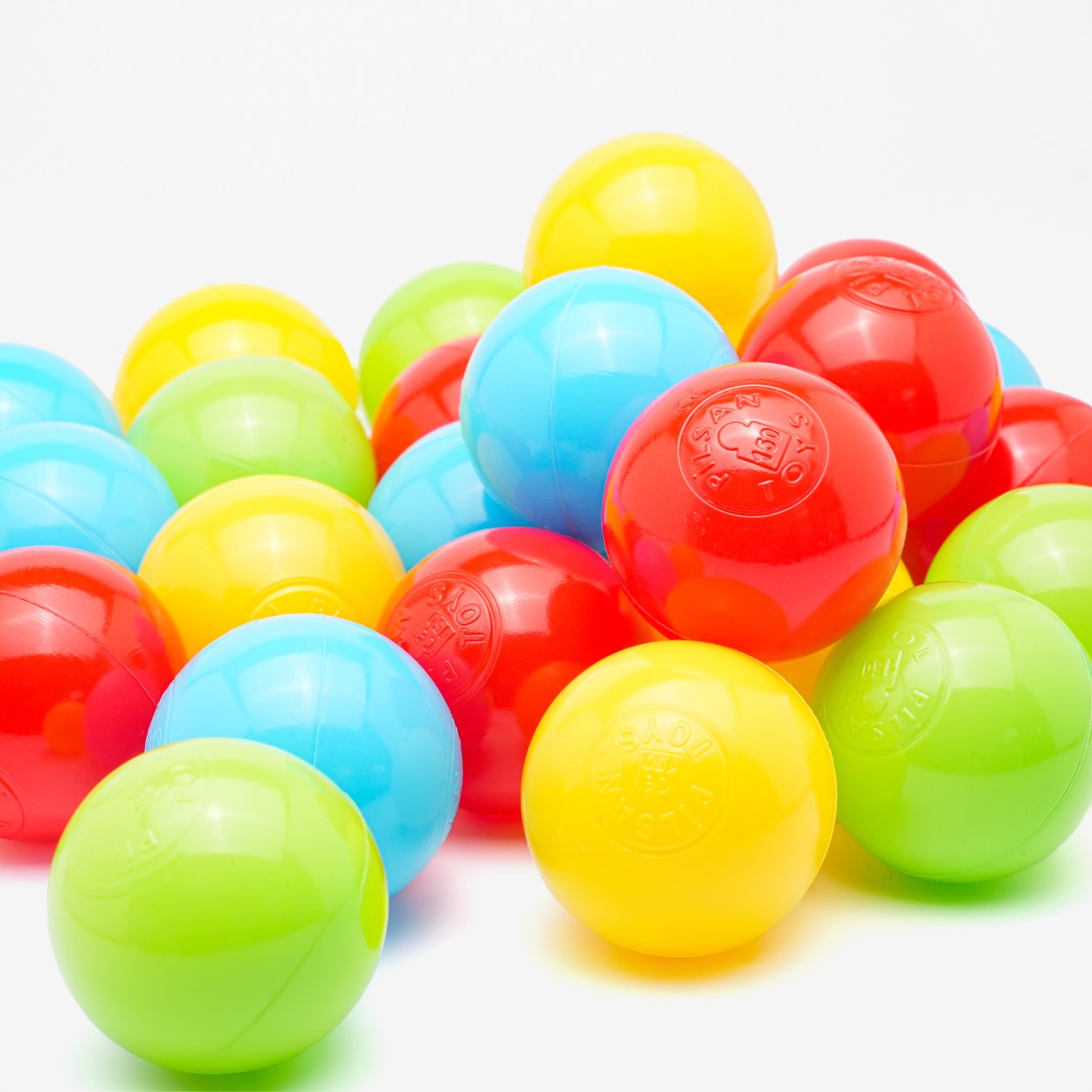
EN71 is the European standard for toy safety, covering mechanical properties, flammability, and chemical composition. CE certification confirms compliance with EU health and safety requirements — still the recognised benchmark across the UK market post-Brexit. Both the pit structure and the balls need EN71 certification. Balls should be hollow, BPA and phthalate-free, and at least 6 to 7cm in diameter to be safe for children under three. All products in our ball pits range meet these requirements without exception.
Foam density
Foam density (kg/m³) is the single most reliable indicator of how long a foam-sided ball pit will last. Foam below 20 kg/m³ compresses quickly under a child's weight and loses its protective properties within months of daily use. For a pit used every day — as happens during British winters when outdoor play isn't an option — look for a minimum of 25 kg/m³. Premium products rated at 35 to 45 kg/m³ give the best long-term durability and safest impact absorption. High-density foam also keeps walls upright rather than slumping outward, which matters practically for containing the balls.
Cover material: PVC vs fabric
PVC covers clean in seconds — a damp cloth with a mild antibacterial spray is all it takes. Waterproof and tear-resistant, they handle years of daily use without degrading. Fabric covers in Oxford polyester or canvas look warmer and are usually removable for machine washing, which is worth confirming before purchase. In a UK household where rainy days mean the pit gets used every day for months at a stretch, wipe-clean PVC is the more practical choice for most families.
Size for UK homes
Allow at least 50cm of clearance on all sides of a ball pit so children can approach from different directions and adults can supervise safely. For most UK living rooms, a footprint no larger than 120cm × 100cm is sensible. Always check the assembled dimensions on the product page — packaged dimensions can be misleading.
Age suitability
Age markings reflect genuine engineering decisions about wall height, ball size, and weight limits. A pit with 25cm sides is safe for a crawling baby but useless for a running two-year-old. Match the product to your child's current developmental stage rather than just their age — NHS milestones put independent sitting around 6 to 8 months, pulling to stand at 9 to 12 months, and confident walking at 12 to 18 months, each suggesting a different ball pit requirement.
Ease of cleaning
Balls should be dishwasher-safe or cleanable in warm soapy water. The pit structure should have no velcro fastenings or deep fabric recesses that trap dirt. For households with children still in nappies, a fully waterproof PVC-covered pit is essential. Build a quick wipe-down into your weekly routine to keep the play environment properly hygienic.
Price guide

Under £100
Pop-up fabric pools and simple inflatables. Fine for occasional use or babies just beginning sensory exploration. Lighter construction, 50 to 200 balls typically included. EN71 certification matters at every price point — do not skip this check regardless of budget.
£100 to £300
The range where most UK parents making a considered long-term purchase will land. Foam-sided pits with PVC panels, 25 to 35 kg/m³ foam density, 200 to 500 balls, solid structural integrity. Many products in our soft play sets at this tier include basic climbing elements and assemble tool-free in under 30 minutes.
£300 and above
High-density foam (35 to 45 kg/m³), OEKO-TEX certified materials, 500 or more balls, modular configurations that can be extended as your child grows. Built to last from infancy to age six. The per-year cost of ownership is lower than it looks, especially for families with more than one child or those who rely heavily on indoor play during the British winter. Our foam playgrounds cover this tier fully.
Age-specific recommendations

0 to 12 months: sensory foundations
A shallow pop-up pool — no more than 20 to 25cm deep — with a small number of lightweight, brightly coloured balls. Balls must be at least 6cm in diameter. An adult should be present throughout. Our baby products range includes sensory play options developed specifically for the first year of life.
1 to 3 years: active exploration
A foam-sided pit with walls at least 40cm high and a minimum of 200 balls. Large enough for two small children to share — parallel play emerges strongly at this age and having a pit that accommodates it well is worth planning for from the outset.
3 to 6 years: imaginative play and physical challenge
A ball pit works best at this age as part of a wider soft play setup — a modular system with a slide or climbing element alongside the pit keeps interest sustained. 300 to 500 balls, neutral colour palette to support open-ended imaginative play. Our soft play sets and foam playgrounds are built for exactly this age group.
Frequently asked questions
What age can a baby go in a ball pit?
Most manufacturers set six months as the minimum, which aligns with when babies typically develop enough head and neck control to sit supported. Always have an adult present for very young children, keep ball quantities modest for babies, and choose a shallow pit with clear sightlines. Every child develops differently — NHS developmental milestones are a useful reference when assessing readiness.
Are ball pit balls safe for babies and toddlers?
Yes, provided they carry EN71 certification and measure at least 6cm in diameter. All balls sold through Soft Play Market are CE certified, EN71 safety tested, and free from BPA and phthalates. Check balls regularly for cracks or splits and replace any damaged ones promptly.
How do I clean a ball pit and the balls?
Wipe PVC-covered pit walls with a damp cloth and mild antibacterial spray. For the balls, place in a laundry net bag and run through a gentle dishwasher cycle on the top rack, or wash in batches in warm water with a small amount of washing-up liquid. Air dry fully before returning to the pit. A thorough clean every two to four weeks is adequate under normal use.
What size ball pit fits in a small UK living room?
For a typical 4m × 5m living room, stay within a footprint of 120cm × 100cm. Pop-up circular pools of 90 to 100cm diameter are particularly space-efficient and fold flat when not in use — ideal where every square metre counts.
How many balls do I need to fill a ball pit properly?
Aim for at least 20 to 25cm of ball depth. A 100cm diameter pop-up pool typically needs 200 to 300 balls. A 120cm × 100cm foam pit needs 300 to 500. Most Soft Play Market products include an appropriate quantity, with top-ups available separately if needed.
Find your perfect ball pit at Soft Play Market
The right ball pit is the one that matches your child's developmental stage, fits your home, is built to a standard that gives you genuine confidence in its safety, and will still be standing after two years of daily use. Whether you start with a compact pop-up pool for a curious baby or invest in a full modular foam playground for an energetic pre-schooler, browse our full ball pits collection — free UK delivery on all orders, every product CE certified and EN71 safety tested.